Before You Choose a Contractor, Know What You’re Saying Yes To

You don’t need to be a construction expert. But you do need to understand the offer, ask the right questions and check who you’re trusting.
Three quotes. Three different prices. And a decision that suddenly feels much bigger than choosing a name from a list.
You read one offer, then another. One sounds reassuring. Another costs less. But the question stays with you: what if I choose the wrong person?
When I look back at building my own house, this is the part I wish I had approached differently. My project ran two seasons late. I wish I had asked for references and called people who had already worked with the contractor.
A real conversation about their experience would have given me something the offer alone could not.
I also wish I had put the offers side by side in a way I could actually follow. Perhaps I would have chosen differently. At the very least, I would have known more about what I was saying yes to.
You are making a big decision in a field that may not be yours
There is a difficult moment in a building project: you are expected to make an expensive decision about work you may never have dealt with before.
If construction is not your profession, how are you supposed to know whether an offer covers everything your project needs? Or whether a reassuring answer is enough?
We cannot know everything about every subject. Building or renovating a home does not suddenly make us construction experts. But we can learn enough to recognise what we do not understand and ask someone to explain it.
You do not need to know everything about construction. You need to know what to ask before you say yes.
That is what being informed means to me. Every clear answer makes the decision a little less of a guess. It cannot remove every risk, but it can help us catch questions we might otherwise leave until the work has started.
Before saying yes, I would check:
- Are the offers pricing the same scope?
- What is excluded, unclear or still unpriced?
- Have I spoken to previous clients?
- Do I have the important answers in writing?
What is that price actually buying?
Today, I would first ask whether the offers cover the same work.
Is electrical work included? What about waste removal, materials and finishes? Which items are excluded? What has been left unclear?
I would write down the requirements for my project and check the same list against each offer. I would keep the contractor’s quoted price separate from my own estimates for anything extra.
A lower number is difficult to judge if one offer includes work that another leaves out. Before deciding which price looks better, I would want to understand what each contractor is actually offering.
Make the call before you make the choice
For a large, expensive project such as building a house, I would ask for references from similar completed projects and contact clients who are willing to share their experience.
This is the call I wish I had made before choosing the contractor for my house.
I would keep it simple: “I’m considering working with them on my house. Would you mind telling me how the project went for you?”
Then I would listen, and ask a few specific questions:
- What work did this contractor complete for you, and was it similar to my project?
- Were you happy with the quality of the finished work?
- How did the actual timeline compare with what you were told?
- If there were delays, how were they explained and handled?
- Were additional costs discussed clearly before the work went ahead?
- How did the contractor respond when something needed correcting?
- Would you choose them again?
The question I would come back to is: “Would you choose them again?”
And then: “Why?” That is where I would want to give the person time to explain. Their experience would not predict mine, but it could show me what deserves a closer look.
You are allowed to ask
“Could you explain what that includes?” is a perfectly reasonable question.
So is “Can you put that in the offer?”
If I did not understand an allowance or a technical term, I would ask what it meant for my house. A conversation can clear things up; a written confirmation gives you something to return to later.
And where a technical question was beyond my knowledge, I would consider getting help from an independent professional with the right expertise. Being informed also means knowing when you need someone else’s knowledge.
Asking questions is part of making a responsible decision about your home and your money.
How a comparison tool could have helped me
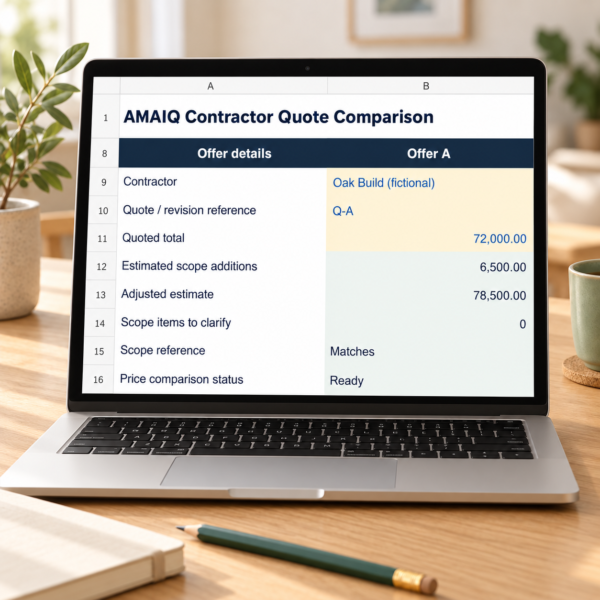
I cannot say that a spreadsheet would have prevented my delays. It would not have told me whether a contractor was reliable. Those reference conversations and other checks would still have mattered.
But I wish I had had a structure that helped me organise the offers, see what was missing or unclear, and prepare the questions I needed to ask.
That is where AMAIQ Contractor Quote Comparison fits. It is an editable Excel workbook with three connected sheets:
- Compare brings together quoted prices and adjusted estimates based on the additions you enter.
- Scope records included, excluded and unclear work, alongside your estimates for extra costs.
- Review provides prompts based on those entries, including an excluded item that still needs a cost estimate.
For example, a fictional $72,000 quote excluding electrical work becomes a $78,500 adjusted estimate when you enter $6,500 for that work. Your added estimate still needs confirmation; it is not an agreed contractor price.
The workbook does not read your quote documents automatically or discover every omission. You supply the information. It helps you work through that information in a more organised way.
What I would tell someone starting now
You do not need to become an expert in everything before building your home. But take the time to understand the offers, ask for explanations and hear from people who have worked with the contractor before.
I wish I had done more of that with my own house. I cannot change that experience, but I can share what I would do differently.
If you are looking at a pile of quotes and wondering where to begin, start with what is included, what is missing and what needs an answer.
Looking for a clearer way to compare your offers?
See the workbook previews and how Compare, Scope and Review fit together.